


Every day, an average of five children end up in the emergency room due to baby gate-related injuries, with falls down the stairs being the leading culprit. As pediatric researchers have discovered, the vast majority of these accidents involve children under the age of two who lean against improperly secured barriers. When it comes to protecting your little ones, understanding Top of Stairs vs. Bottom of Stairs: Why Baby Gate Hardware Requirements Differ Drastically is the most critical step you can take. The hardware that perfectly secures the bottom step can be a catastrophic hazard if used at the top landing.
As certified professional childproofers, we have spent years specializing in infant safety, evaluating thousands of homes, and successfully securing countless staircases. We know firsthand that parents are often overwhelmed by the sheer volume of safety products on the market. That is why we are breaking down the exact physics, mechanical differences, and structural requirements that dictate which gate belongs where. Our goal is to replace confusion with absolute confidence, ensuring your home is a safe haven for your growing explorer.
The Physics of Stairway Falls: Why Top-Heavy Toddlers Dictate Hardware Choices
How a Toddler’s Center of Gravity Impacts Gate Force
Babies and toddlers are uniquely proportioned. Because their heads are disproportionately large and heavy compared to their bodies, they have a much higher center of gravity than adults. This makes them naturally top-heavy. When a toddler stands at a barrier and leans forward, shakes the bars, or attempts to pull themselves up, the force they exert is concentrated high up on the gate. If a gate gives way, their high center of gravity means they are prone to tumbling headfirst, which significantly increases the risk of traumatic brain injuries. Our lead safety evaluator, drawing on a background in pediatric nursing, always emphasizes that a gate must withstand not just a child’s weight, but the dynamic, top-heavy force of a determined toddler.
The Dangers of Downward Momentum at the Top Step
At the top of a staircase, the stakes are exponentially higher. A child leaning against a top-step barrier is not just pushing against the gate; they are pushing against the empty space of the stairwell behind it. If the gate fails, downward momentum instantly takes over. The combination of a top-heavy toddler and the steep decline of a staircase creates a highly dangerous scenario. This basic law of physics is the primary reason why hardware requirements change so drastically depending on the location of the installation.
Top of the Stairs: The Strict Requirement for Screw-Mounted Hardware
Why Pressure-Mounted Systems Are Strictly Prohibited
When analyzing Top of Stairs vs. Bottom of Stairs: Why Baby Gate Hardware Requirements Differ Drastically, the most absolute rule is that pressure-mounted systems must never be used at the top of a staircase. Pressure gates rely on tension against the walls or banisters to stay in place. While they might feel sturdy to a gentle push, the repeated shaking and pulling from a toddler can easily loosen the tension over time. More dangerously, pressure gates feature a U-bar frame with a bottom rail that rests directly on the floor. This bottom rail creates a severe trip hazard. If an adult trips over this bar while carrying a baby at the top of the stairs, the results can be devastating.
Anchoring Requirements: Securing Hardware into Studs and Solid Wood
To completely eliminate the risk of a gate being pushed out, top-of-stair gates must be hardware-mounted. This means the gate is physically screwed into the structural framing of your home. As authorized installers for premium safety gate manufacturers, we know that drywall anchors are never sufficient for top-of-stair installations. The hinges and latching mechanisms must be driven directly into wooden wall studs or solid wood banisters. Our installation technicians, who undergo rigorous background checks, are trained to locate these structural supports to ensure the gate becomes an immovable extension of your home’s architecture. We have seen the damage left behind by amateur handymen who relied on flimsy drywall anchors, and we guarantee our custom gate installations will never compromise your child’s safety or your home’s integrity.
Bottom of the Stairs: Hardware Flexibility and Pressure-Mounted Options
Safe Applications for Pressure-Mounted Gate Systems
The bottom of the staircase presents a different physical environment. Here, the child is pushing the gate toward the solid steps rather than an open drop. Because the risk of a downward fall is removed, pressure-mounted systems are often deemed safe and appropriate for this location. A pressure-mounted gate can effectively deter a crawling infant from ascending the stairs unsupervised. However, it is vital to check the tension regularly, as the gate can still be dislodged if a child uses it to pull themselves up repeatedly.
Heavy-Duty Fabric Barriers and Alternative Bottom-Step Solutions
For the bottom of the stairs, parents also have the option of using heavy-duty fabric barriers. These modern solutions roll or fold out of the way when not in use, providing a seamless look without a tripping hazard. When we design a customized safety plan for families, we often recommend these flexible options for the bottom step. Parents often harbor safety and quality doubts when trusting someone to secure their home, especially regarding the durability of materials. We exclusively use non-toxic materials and premium products that can withstand intense toddler tampering, ensuring that even the most flexible bottom-of-stair solutions provide an impenetrable barrier.
Swing Direction and Trip Hazards: Mechanical Hardware Differences
Directional Stop Hardware: Ensuring Gates Only Swing Over Landings
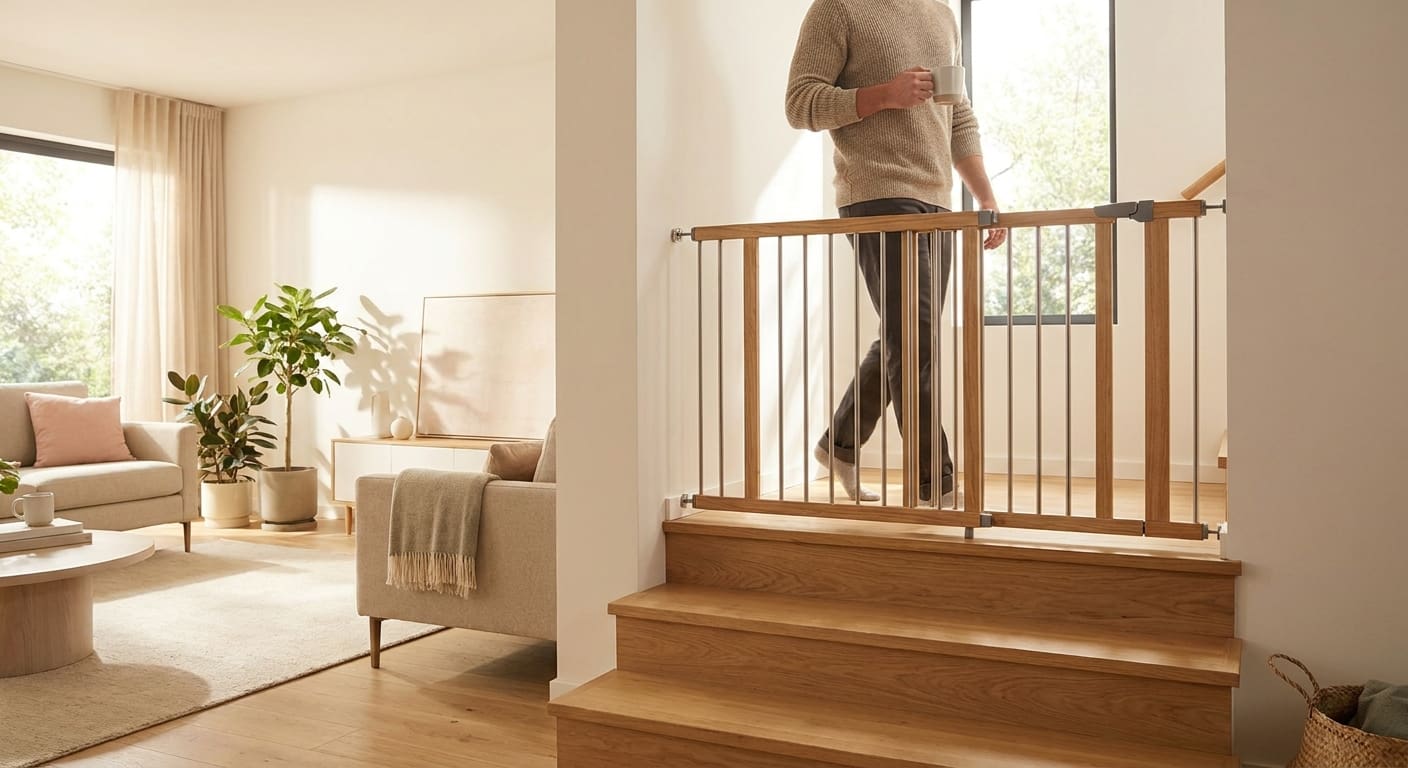
Another crucial element of Top of Stairs vs. Bottom of Stairs: Why Baby Gate Hardware Requirements Differ Drastically is the swing direction. A gate at the top of the stairs must feature directional stop hardware. This mechanical bracket or stopper physically prevents the gate from swinging out over the descending stairs. It forces the gate to only open inward, toward the landing. If a gate were to swing out over the stairs, a person stepping through would have to awkwardly reach forward and step down simultaneously, drastically increasing the risk of a fall.
The Danger of U-Bar Frames and Thresholds at the Top of Stairs
As mentioned earlier, pressure-mounted gates require a U-bar frame to maintain tension. This frame includes a metal threshold that runs along the floor. Placing any threshold at the top of a staircase is a massive safety violation. Hardware-mounted gates designed for the top of the stairs do not have this bottom bar; when the gate is open, the walkway is completely clear. We understand the frustrations families have experienced with past service providers who left dangerous screws on the floor or installed inappropriate gates that caused tripping hazards. Our protocol ensures that we only install threshold-free gates at the top of stairs, and we leave your home completely clean and free of drilling dust after the installation is complete.

Understanding Staircase Anatomy and Complex Layouts
Identifying Mounting Points: Newel Posts, Balusters, and Stringers
Every staircase is unique, and understanding its anatomy is essential for a secure installation. The heavy, vertical post at the end or turn of a handrail is called the newel post. The smaller vertical spindles are balusters, and the structural board running along the side of the stairs is the stringer. When securing a gate, the newel post is the primary anchor point. However, not all newel posts are perfectly square or made of solid wood, which introduces complexities that require professional expertise.
Navigating Wall-to-Post and Post-to-Post Hardware Adapters
Many homes feature a wall on one side of the stairs and a banister on the other, or banisters on both sides. Drilling directly into a decorative newel post is a common hesitation for parents who want to preserve their home’s aesthetic. To solve this, we utilize specialized wall-to-post and post-to-post hardware adapters. These mounting kits strap securely around the newel post without requiring any drilling into the wood itself, providing a solid foundation for the gate’s hinges or latch while protecting your banister from permanent damage.
Securing Gates to Round Banisters, Curtail Steps, and Uneven Baseboards
Modern architecture often includes round banisters, decorative curtail steps (the rounded, wider step at the very bottom), and thick or uneven baseboards. Standard gate hardware rarely fits these features out of the box. Our childproofing process is designed to handle these exact challenges. We start with a comprehensive in-home hazard assessment, followed by a customized safety plan with specific product recommendations tailored to your staircase’s unique geometry. We then schedule a convenient time for the secure installation—guaranteeing prompt service so there are no delays before your baby starts crawling. Finally, we conduct a final walkthrough to teach you exactly how to operate the new safety devices.

Meeting ASTM F1004 Safety Standards for Stairway Gates
What the ASTM F1004 Certification Means for Gate Hardware
When evaluating baby gate hardware, the most important credential to look for is the ASTM F1004 certification. This safety standard dictates the mandatory requirements for children’s gates and enclosures, ensuring they can resist significant push-out forces and do not pose head or neck entrapment hazards. Recent updates to these standards strictly require warning labels on pressure-mounted gates stating that wall cups must be installed to prevent a child from pushing the gate out. As safety experts, we ensure that every piece of hardware we install meets or exceeds these rigorous national standards.
Final Safety Checklist for Stairway Gate Selection and Hardware
To ensure ultimate peace of mind, always follow this final safety checklist:
- Location Check: Verify that only hardware-mounted gates (screwed into studs or with secure post adapters) are used at the top of the stairs.
- Threshold Check: Ensure the top-of-stair gate has no bottom U-bar or tripping hazard.
- Swing Check: Confirm the directional stop is engaged so the gate only swings over the landing, never over the stairs.
- Certification Check: Look for the ASTM F1004 certification label on the gate’s packaging or frame.
- Maintenance Check: Regularly inspect latches, hinges, and tension levels to ensure the gate remains secure.
We know that inviting strangers into your private living space to perform these installations can be daunting. That is why our friendly customer service representative helps you schedule your initial walkthrough, and our fully vetted team arrives on time, respecting your toddler’s nap schedule. We differentiate our business by proving how deeply we care about your family’s well-being. This includes our customer commitment policy: a promise to return and adjust any safety gate that becomes loose within the first year, and a lifetime guarantee that our magnetic cabinet locks will withstand toddler tampering. By understanding the critical hardware differences between the top and bottom of your stairs, and partnering with dedicated professionals, you can confidently protect your child from stairway falls.
No stud at the landing—secure baby gates without studs shows safe ways to mount a top-of-stairs gate without risky drywall anchors.