


Choosing a baby gate for a home with a large dog means guarding against two very different kinds of force: the slow, persistent push of a determined toddler and the sudden, powerful lunge of an adult dog. The right installation strategy makes the same barrier safe for both, but only if you match the gate type, height, and mounting method to the specific behaviour of your dog and the age of your child. This guide covers baby gates in homes with large dogs: installation strategies for dual-purpose safety.
We focus on practical choices that hold up in real homes, where a single gate often needs to stop a boxer from charging up the stairs and a toddler from toppling through an open doorway.
Understanding Different Types of Baby Gates for Large Dogs
Not every gate that keeps a baby safe will contain a large dog. We group the most common options into three categories and explain where each fits a home with both children and big dogs.
Pressure-Mounted Gates
Pressure-mounted gates use tension against the door frame or wall to stay in place, which means no drilling and easy relocation. They are fine as temporary barriers in low-traffic areas, but we do not recommend them for homes with large dogs that push, jump, or lean heavily. A determined 60-pound dog can shift a pressure-mounted gate by repeatedly bumping it, and the gate’s bottom bar can become a tripping hazard. Reserve these for short-term containment of a calm, older dog, and never use them at the top of stairs.
Hardware-Mounted Gates
Hardware-mounted gates screw directly into wall studs or solid wood framing, making them the strongest option for dual-purpose safety. They are the only type we recommend for the top of stairs or for containing large, high-energy breeds. The fixed brackets hold the gate in a precise position, so a dog cannot dislodge it by hitting the latch or pushing at the corner. The trade-off is that installation leaves small holes, but the safety benefit outweighs the cosmetic cost in most homes.
Freestanding and Retractable Gates
Freestanding gates with support feet can block wide openings like fireplaces or room dividers, but their stability depends on the floor surface and the dog’s behaviour. Most large dogs can push a freestanding panel out of position unless it is anchored. Retractable fabric gates roll up out of the way and are useful for long openings, but they must have hardware-mounted end posts rated for heavy loads. Check that the mesh is dense enough to prevent a dog from seeing through and jumping over, and that the latch resists nose pokes.

Blocking a hearth is different from a doorway; freestanding fireplace gates vs mounted screens explains tipping risks, heat clearance, and when to add wall anchors.
Key Safety Features and Standards for Dual-Purpose Gates
When a gate has to protect both an infant and a large dog, you cannot compromise on safety certifications or lock quality.
ASTM F1004 Compliance
We look for gates that meet ASTM F1004, the voluntary safety standard for expansion gates and expandable enclosures intended for children up to 24 months. This standard covers spacing between slats (to prevent head entrapment), structural integrity, and stability under load. A gate that meets this standard has been tested to resist the forces a toddler can apply. For large dogs, we then verify separately that the gate’s frame and latch can handle much higher force, because ASTM F1004 does not test for a 40-kilogram dog lunging at the gate.
One-Handed Operation and Secure Locking
The latch must open easily with one hand while you hold a child or a leash, but it must be impossible for a dog to operate. We recommend dual-action locks that require two distinct motions, such as lifting and sliding, which most dogs cannot perform with their nose or paw. Also check that the gate swings shut and latches automatically when released, and that the latch has no protruding edges that could snag clothing or fur.

Choosing the Right Size: Height and Width Considerations for Large Dogs
Height and width mistakes are the most common reasons a gate fails in a home with large dogs.
Minimum Height to Prevent Jumping
For large breeds, a gate shorter than 30 inches is rarely enough. We use a minimum of 36 inches for medium-large dogs and 40 inches or more for athletic jumpers like retrievers, shepherds, and hounds. Measure the dog at the shoulder and consider motivation: a dog that jumps a gate to reach a family member will jump higher than one that is simply exploring. Taller gates with vertical bars and no horizontal foot rails discourage climbing.
Measuring Width for Proper Fit
Measure the opening at the exact point where the gate will sit, not the door frame overall. Hardware-mounted gates often come with extension pieces to cover a range, but gaps at the sides must be tight enough to prevent a child from slipping through or a dog from wedging its head. Most safety gates list a maximum and minimum width; choose one that allows at least 2 inches of adjustment beyond your measured width for fine-tuning during installation.

Dealing with wide archways or no door frames, effective ways to gate open-concept spaces covers stable layouts, banister-friendly anchors, and when to split zones.
Placement Strategies: Where to Install Gates for Maximum Safety
The best gate in the wrong spot creates as many risks as no gate at all.
Top and Bottom of Stairs
At the top of a staircase, only a hardware-mounted gate is safe. A pressure-mounted gate can be knocked loose by a running dog, sending both the dog and the gate down the stairs. Mount the gate so it swings away from the stairs, not over them, and ensure the latch is on the landing side. At the bottom of stairs, a hardware-mounted gate is still preferable because a large dog jumping up can apply upward force that loosens pressure mounts.
Doorways and Hallways as Safe Zones
Use gates to create clear, consistent zones: the nursery stays dog-free, the kitchen is off-limits during food prep, and a hallway can become a calm retreat for the dog. Keeping the dog on one side of a gate while the baby plays on the other allows both to see and hear each other, which reduces anxiety and treats the gate as a neutral boundary rather than a punishment. Place gates so the dog still has access to water, a comfortable bed, and a window view if they will be behind the gate for more than a short time.

At stairs, details matter; how hardware requirements change by location shows why top landings demand fixed mounts, swing direction, and latch placement that differ from bottom setups.
Hardware-Mounted vs Pressure-Mounted Gates: Installation Methods for Durability
Both mounting methods have a place, but large dogs tip the balance heavily toward hardware.
Pros and Cons of Hardware Mounting
Hardware-mounted gates are the gold standard for dual-purpose safety. Pros: they resist horizontal and vertical force, they cannot be pushed out of alignment, and they can be installed on angled or uneven surfaces using banister adapters. Cons: they require drilling into walls or banisters, and they are semi-permanent. If you rent, you may need permission, but many manufacturers sell adapter kits that avoid drilling into wood banisters by using straps or clamps around the post.
When to Use Pressure Mounting
We use pressure-mounted gates only in doorways at floor level, in homes with calm, senior dogs that do not jump or lean, and only for short periods. They are useful for temporary separation during a visit or as a secondary barrier inside a room. If you must use a pressure mount with a large dog, choose one with extra-wide tension pads and check the tightness weekly, because repeated pressure will gradually loosen the contact points.
For glass railings, no-drill baby gate methods for glass outline clamp and strap systems that avoid holes, protect panels, and still create a rigid, code-compliant barrier.
Materials and Durability: Selecting Chew-Resistant Gates
A gate is only as strong as the material it is made from, and large dogs test materials with teeth and claws.
Metal vs Wood vs Plastic
We recommend powder-coated steel or heavy-gauge aluminium for homes with large dogs. Metal resists chewing, scratching, and bending, and powder coating prevents rust and chipping. Wood gates look nicer but can splinter under heavy chewing, and even pet-safe finishes wear off quickly. Plastic gates are lightweight and portable, but they crack under sustained force and are not suitable for any dog over about 25 pounds unless the gate is specifically rated for large breeds.
Features That Resist Chewing and Scratching
Look for gates with vertical slats spaced no more than 3 inches apart to prevent both child head entrapment and dog jaw wedging. Avoid gates with exposed corners or thin plastic caps that a dog can gnaw off. A smooth, rounded frame without sharp edges protects both toddler fingers and dog paws. If your dog is a persistent chewer, consider a gate with replaceable chew guards or a metal mesh panel that offers no purchase for teeth.
Training Your Dog to Respect Baby Gates
Even the strongest gate benefits from a dog that has learned to leave it alone.
Positive Reinforcement Techniques
Never use a gate as a punishment or force the dog against it. Instead, teach the dog to go to a mat or bed behind the gate on cue. Start with the gate open, lure the dog onto the mat with a treat, and reward calm behaviour. Then close the gate briefly, reward again, and open it before the dog gets frustrated. Gradually increase the duration. This turns the area behind the gate into a positive, low-stress holding zone rather than a barrier to fight.
Managing Jumping and Pushing Behaviors
If your dog pushes on the gate or jumps at it, do not yell or bang the gate, which increases arousal. Instead, wait for a pause in the behaviour, mark it with a clicker or a word like ‘yes,’ and toss a treat away from the gate. This teaches the dog that calmness near the gate brings rewards. For dogs that jump, place a second visual barrier, such as a sheet or fabric panel, on the dog’s side temporarily so the dog cannot see the exciting target. Once the jumping stops, remove the visual block.
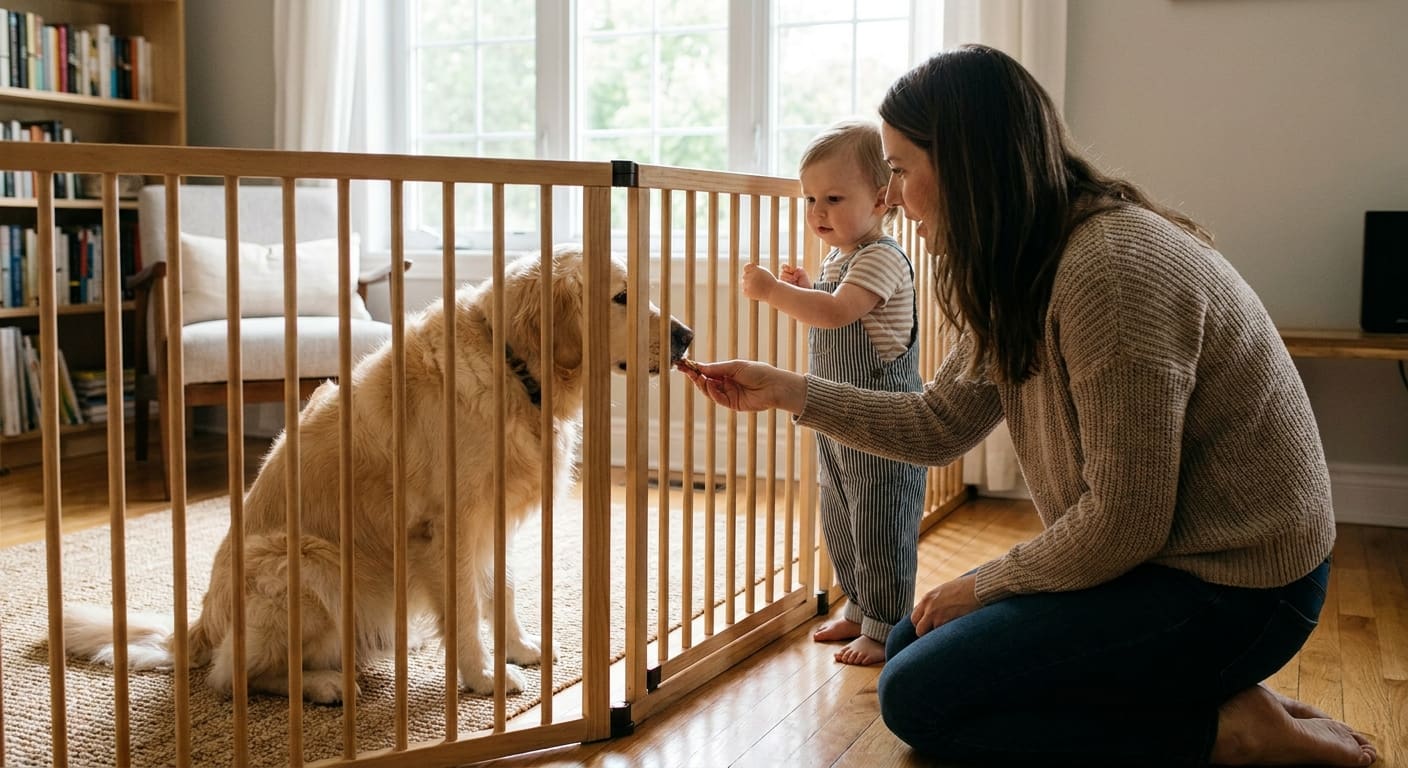
Baby Gates vs Dog Gates: Can One Gate Serve Both Purposes?
The short answer is yes, but only if the gate meets child safety standards and is built for the force of a large dog.
Differences in Design and Safety Standards
Dog-specific gates are often taller and reinforced, but they may not carry ASTM F1004 certification. That certification is essential for any gate used around children under two. Some dog gates have wider bar spacing or latch designs that a toddler’s hand could fit through or operate. Conversely, many baby gates are not strong enough for a 70-pound dog. We reject any gate for dual use unless it explicitly states compliance with ASTM F1004 and has a metal frame, tall height, and a dual-action latch.
Key Considerations for Dual Use
When evaluating a single gate for both jobs, we check four things: height (at least 36 inches), latch resistance (dog cannot open it, adult can with one hand), slat spacing (no more than 3 inches), and material (metal, not plastic or thin wood). We also verify that the gate can be mounted at the top of stairs if that is the intended location. If a gate fails any of these, it is safer to install two different gates: a certified baby gate for child-only zones and a tall dog gate for the dog’s area, even if that means more hardware in the home.
Conclusion: Creating a Safe Environment for Both Children and Large Dogs
Dual-purpose safety does not come from buying the most expensive gate or the one with the most features. It comes from matching the gate type, height, mounting method, and material to the real behaviour of your dog and the developmental stage of your child. Start by measuring every opening, choosing hardware-mounted gates for stairs and high-force areas, and training your dog to see the gate as a cue for calm settling. Then reassess every few months as your dog ages and your child grows. If you need help selecting or installing a gate that will truly hold up to a large dog and a curious toddler, ask a professional childproofing service for an in-home assessment.